The Door Hangs Crooked
One side sits higher than the other, or the bottom seal no longer meets the floor evenly. Stop movement before the door racks farther in the opening.
Serving Starke, Florida
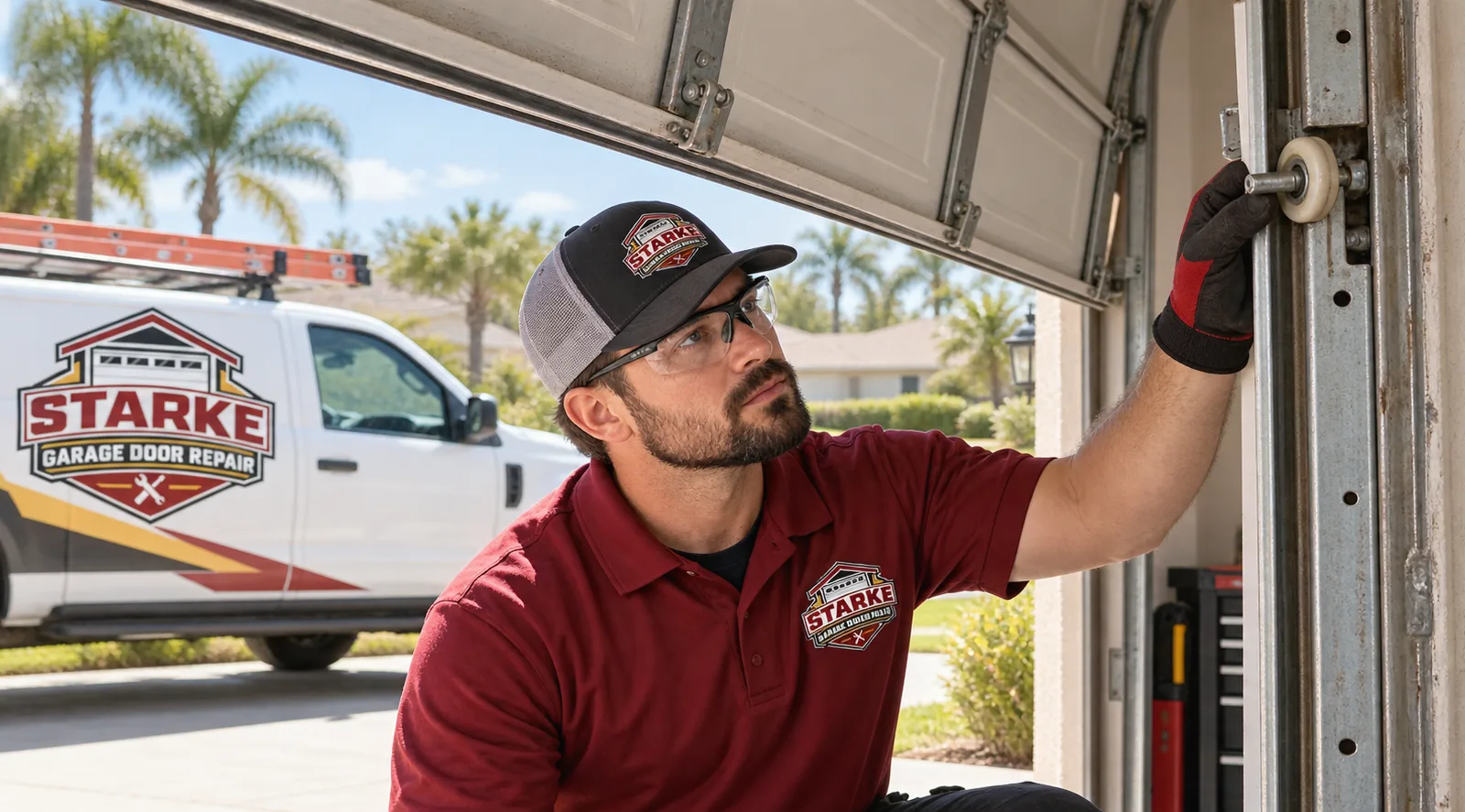
Off-track repair in Starke, Florida
Get a jammed or crooked door inspected, realigned, and checked for the damage that caused it to leave the tracks.
Stabilize before moving
When a roller comes out of its track, the door may hang crooked, bind during travel, or stop moving altogether. Continuing to operate it can bend the track farther, dislodge additional rollers, strain the opener, or allow the door to drop unexpectedly. Keep people, vehicles, and stored items away from the opening. Do not pull the emergency release when the door is raised or visibly uneven.
We provide garage door off track repair in Starke, FL for displaced rollers, bent track sections, loose brackets, jammed doors, and related alignment problems. The work starts with the door secured in place. The track, rollers, hinges, lift cables, drums, springs, and opener connection can then be checked before anything is moved. This matters because putting a roller back into the track does not correct a damaged cable, loose mounting point, or track that has shifted out of position.
Off-track doors can involve safety risk, and safe diagnosis comes first. Share whether the door is open or closed, whether a vehicle is trapped, and what happened just before the problem appeared. Those details help Starke Garage Door Repair prepare for the condition at the opening.
Diagnose the underlying fault
A track is meant to guide the rollers while the springs and cables carry and control the door's weight. The system can bind when a vertical track is bent, a bracket loosens, or debris blocks the roller path. Worn rollers may tilt or seize instead of turning smoothly. Impact near the opening can also push a track inward and reduce the clearance needed for normal movement.
A door that rises unevenly may have a lift cable problem. If one side loses tension or a cable slips from its drum, that side can lag while the other continues upward. The door may rack in the opening and force rollers against the track. A broken spring can create a similar imbalance and should be treated as a separate high-tension repair, not as a simple alignment adjustment.
Florida humidity and wind-driven rain can contribute to corrosion on exposed fasteners and steel parts, especially near the lower track area. The right response is to inspect the cause rather than assume every displaced roller needs the same fix. If the problem involves broader operation rather than a visibly displaced roller, garage door repair in Starke can address the affected system as a whole.
Warning signs
One side sits higher than the other, or the bottom seal no longer meets the floor evenly. Stop movement before the door racks farther in the opening.
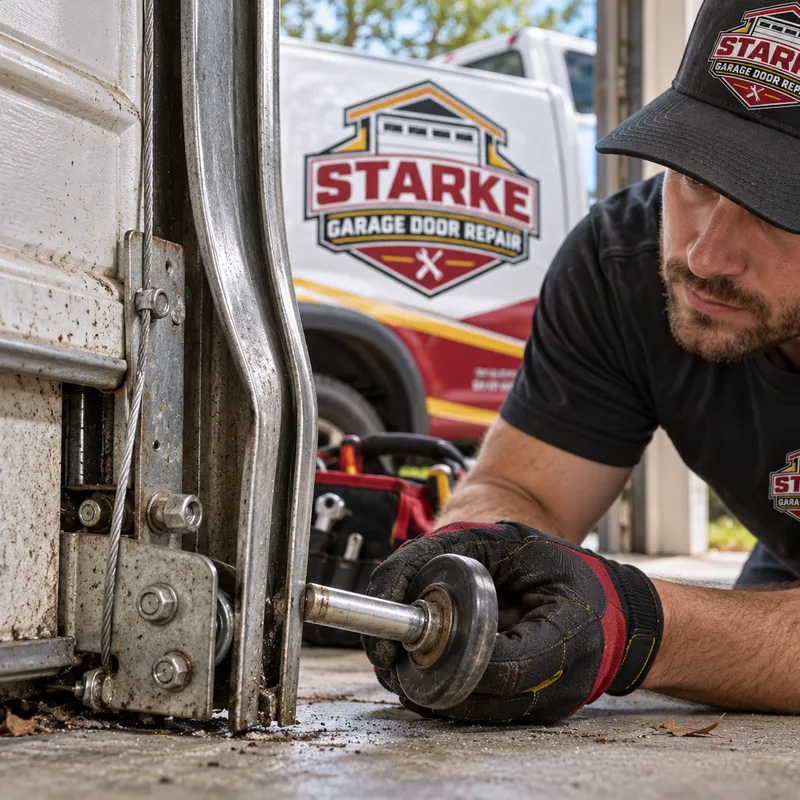
The roller stem may remain attached to the hinge while the wheel sits beside the track. Forcing it inward can damage the hinge, roller, or track lip.
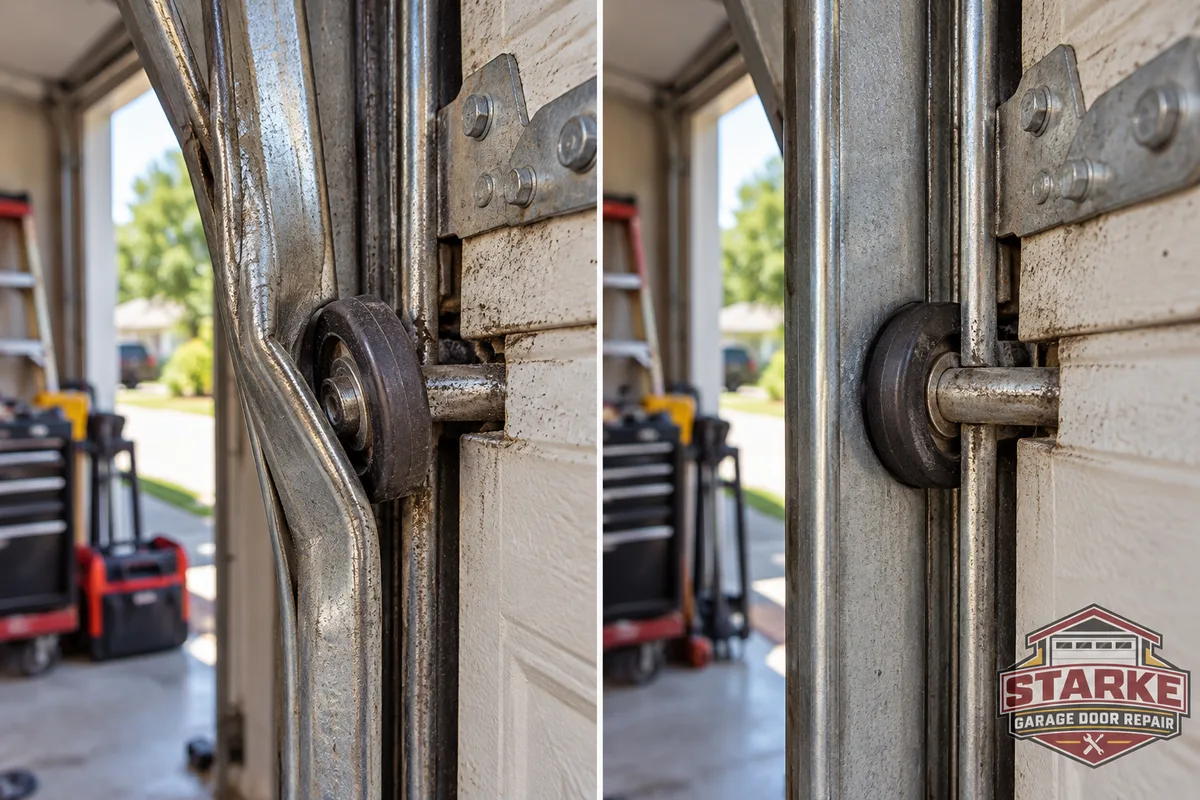
A crease, inward bend, widened seam, or loose wall bracket can interrupt the roller path and cause repeated binding.
Slack beside the door or an uneven cable on the drum points to a lifting-system problem. Cables and drums remain connected to spring tension and require controlled handling.
An opener may stop, reverse, or make unusual noise when the door is jammed. Repeated use can add force without correcting the obstruction.
A stuck door may be wedged in the opening or supported unevenly. Leave it in place and arrange an inspection rather than pushing or pulling it by hand.
Service sequence
We first stabilize the door to limit movement. The opener is kept from operating while the door's position and balance are assessed.
The inspection covers track spacing and alignment, rollers, hinges, brackets, cables, drums, springs, and the points where the tracks attach to the structure. Any impact damage or obstruction is identified.
Depending on condition, the work may include guiding rollers back into position, straightening a serviceable track, replacing damaged rollers or hinges, tightening brackets, or replacing a track section that cannot be aligned reliably.
The vertical and horizontal tracks are positioned so the rollers have suitable clearance through the full travel path. Fasteners and mounting points are checked before testing begins.
The door is moved cautiously by hand to check balance, clearance, and smooth roller travel. The opener is reconnected only when the door can move without binding, and its travel is then checked.
Repair decisions
A slightly shifted track may be reusable if its profile is intact, its mounting points are sound, and the rollers can pass through it without binding. Loose brackets can sometimes be repositioned and fastened after the door is stabilized. Rollers that remain round, rotate properly, and have straight stems may also stay in service.
Replacement is the better choice when track steel is sharply creased, split, badly twisted, or unable to hold alignment. A roller with a cracked wheel, worn bearing, or bent stem can create another jam even after the door is reset. Bent hinges and damaged brackets also affect roller position. Matching the replacement track profile and hardware to the existing door is necessary because track configurations and roller sizes are not interchangeable in every system.
An off-track condition tied to a frayed cable, damaged drum, or broken spring requires repair of that fault before normal operation resumes. The aim is not merely to make the door look straight. It must travel evenly, remain supported on both sides, and pass through the curved track without scraping or climbing the rail.
A crooked or jammed garage door can become more difficult to control with each attempt to move it. Arrange an inspection before operating the door again.
CALL NOW: (904) 966-4094Common questions
Do not attempt it when the door is crooked, raised, under uneven cable tension, or connected to an opener that may activate. A garage door is heavy, and the spring and cable system stores substantial force. Starke Garage Door Repair can stabilize the door, identify why the roller escaped, and determine whether the track and hardware remain usable.
The door should remain still until its support and cable condition are checked. Opening a racked door can pull out more rollers or allow one side to fall. When requesting service in Starke, explain the door's current position and whether a vehicle is blocked so the access problem is clear before work begins.
A bent track does not always require replacement, but sharp creases, splits, severe twists, and damaged mounting areas usually make replacement more appropriate. Minor deformation may be repairable if the track can hold alignment and provide a clear roller path. We determine that after the door is secured and the full track run is inspected.
Extensive impact damage or multiple failed parts add work beyond a straightforward roller reset and track alignment. The door's position, cable condition, track damage, and availability of matching components determine the work involved. Starke Garage Door Repair confirms the repair plan after inspection.
Repeat displacement usually means the underlying cause was not corrected. Possible causes include a bent track, incorrect track spacing, a loose bracket, a seized roller, a damaged hinge, an obstruction, or uneven cable travel. The complete roller path and lifting system should be checked before the door returns to use.
Prevent the opener from being activated, but do not pull the emergency-release handle while the door is raised, crooked, or unsupported. Releasing the trolley can remove the opener's restraint and let an unbalanced door move suddenly. Wait until the door has been stabilized by someone equipped to control it.
Get started
Tell us whether the door is crooked, jammed, open, or blocking a vehicle. An inspection can identify the failed parts and establish the right repair before the door moves again.