
Opening and Clearance
Measurements should cover the framed opening as well as the headroom, side room, and backroom needed for the tracks and spring assembly.
Serving Starke, Florida
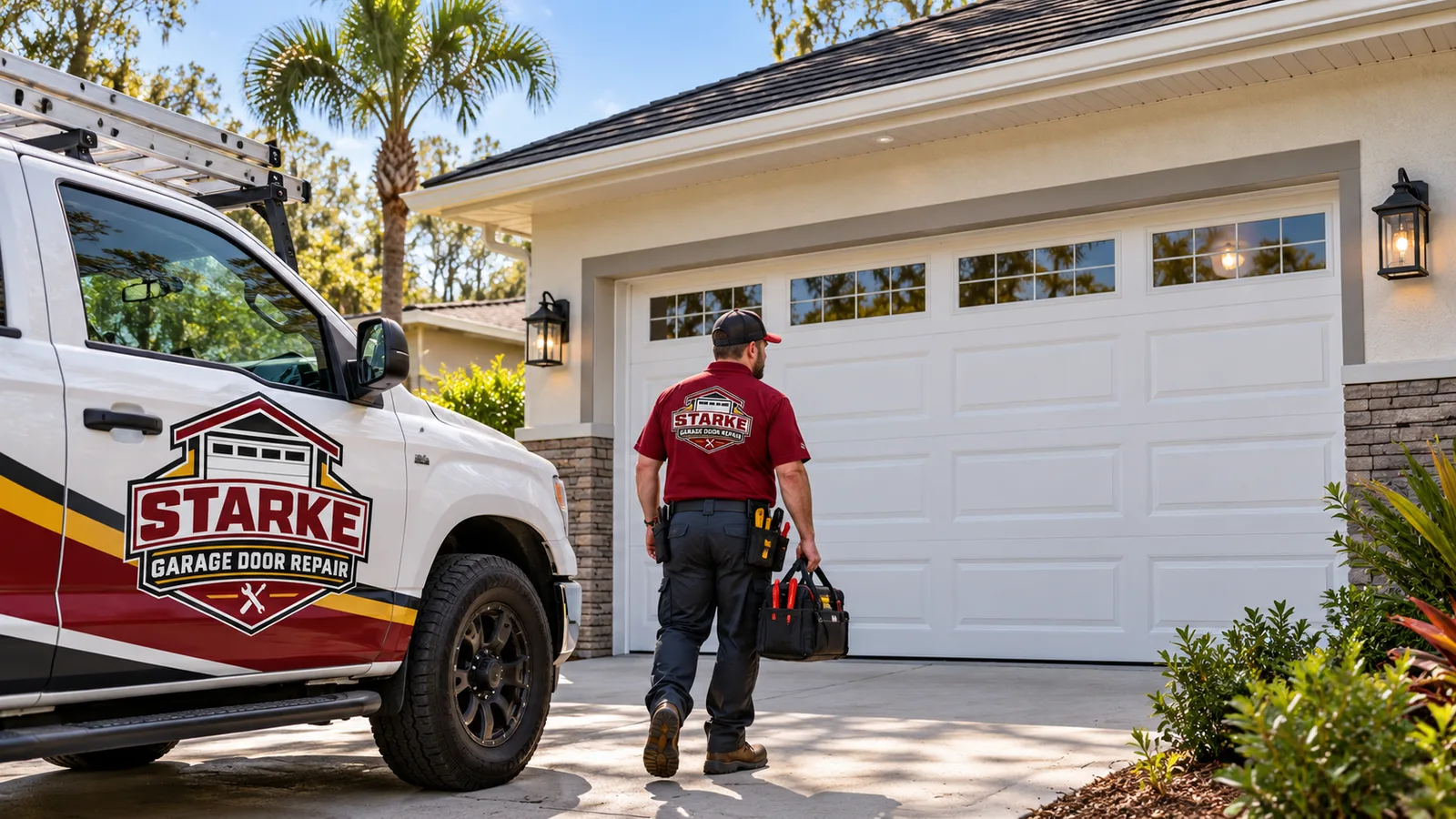
Garage door installation in Starke, Florida
Plan a properly sized, balanced door with careful removal, track setup, alignment, and final operating checks.
Measure before installation
Garage door installation in Starke, FL starts with accurate measurements and a clear understanding of the existing opening. We assess the width, height, headroom, side room, backroom, framing, and floor condition before the new system is set up. Those details determine whether the selected door and track configuration fit the garage.
A complete installation involves more than placing panels in an opening. The work may include removing the old door, assembling the new sections, setting vertical and horizontal tracks, installing the spring system, attaching lift cables and rollers, and checking the door's balance. If an opener will operate the new door, its rail, travel limits, and force settings must suit the finished installation.
Starke's humid, rain-prone North Florida climate makes material selection and weather sealing important. Galvanized hardware, a sound bottom seal, and properly fitted perimeter weatherstrip help reduce exposure to moisture and wind-driven rain. Wind-load requirements also depend on the property and applicable building rules, so the selected door should match the approved installation specifications for that opening.
Door selection
The right garage door depends on the opening, daily use, appearance, and level of insulation wanted. Common residential choices include steel sectional doors, insulated sandwich-style doors, non-insulated pan doors, and carriage-style designs that operate as overhead sectional doors. Window inserts, panel profiles, colors, and decorative hardware affect appearance but must remain compatible with the door model.
Insulation is commonly expressed through R-value. A higher R-value indicates greater resistance to heat flow, but how much it helps depends on how the garage is built and used. Insulation may be worth considering when the garage shares walls or a ceiling with conditioned rooms, receives strong afternoon sun, or is used as a work area.
Door weight affects the spring selection. Torsion springs are mounted on a shaft over the opening, while extension springs run along the horizontal tracks. These systems are not interchangeable without the correct hardware and layout. Starke Garage Door Repair can review the opening and proposed door so the tracks, springs, drums, cables, and rollers are specified as one working system.
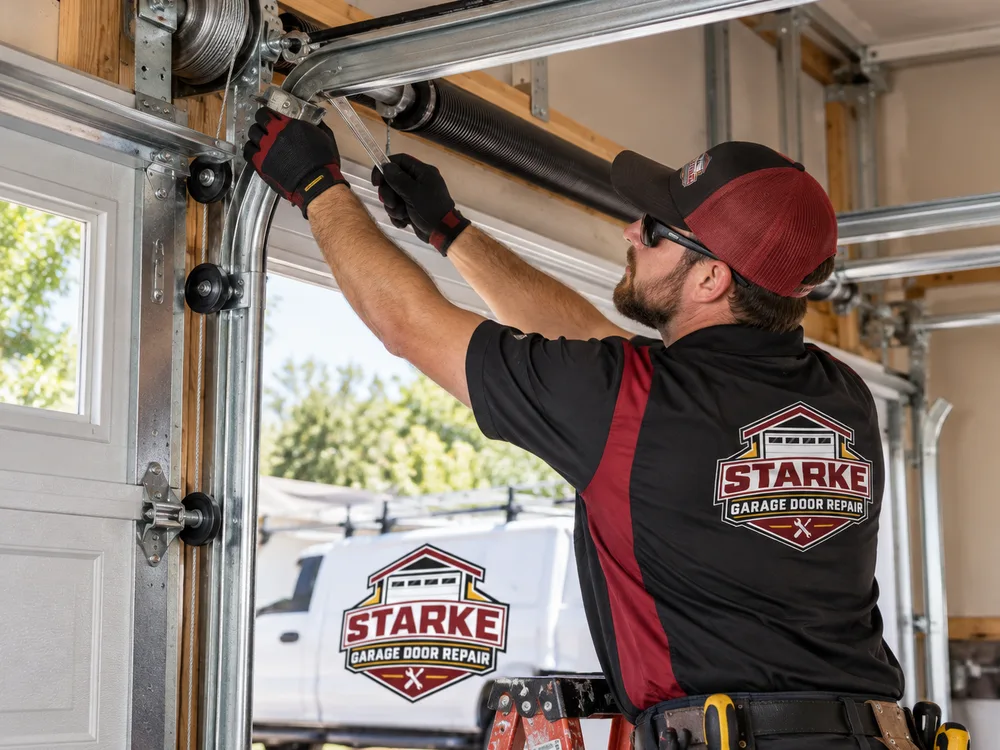
Complete system setup
Measurements should cover the framed opening as well as the headroom, side room, and backroom needed for the tracks and spring assembly.
Hinges, rollers, brackets, struts, cables, and fasteners must match the manufacturer's specifications for the selected door.
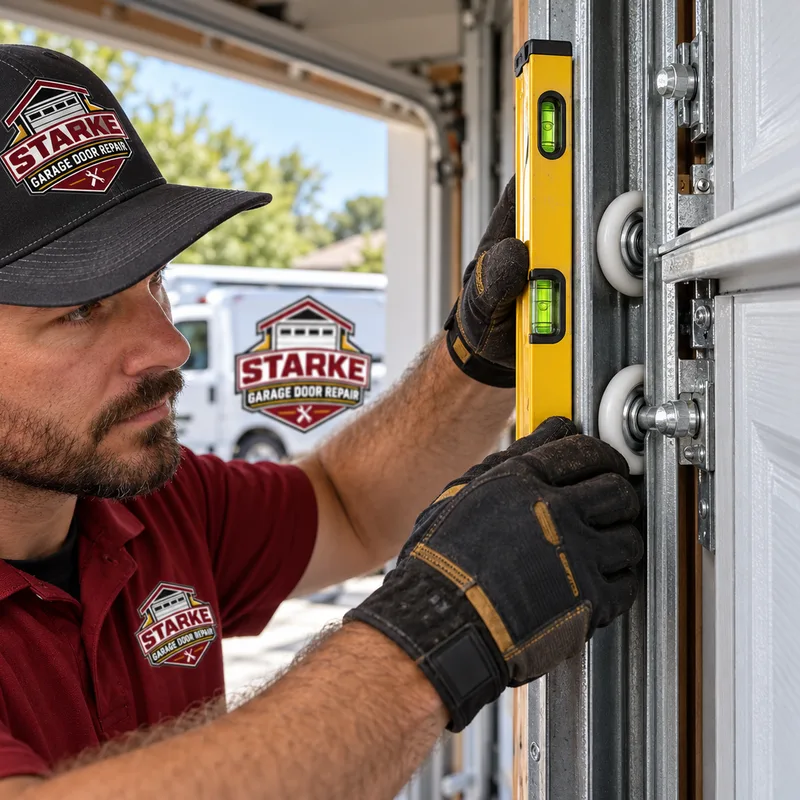
Vertical tracks should be plumb, horizontal tracks should be properly supported, and spacing should let the rollers travel without binding.
Correctly selected and adjusted springs counterbalance the door. A disconnected door should move under controlled hand pressure rather than dropping or rising on its own.
The bottom seal and perimeter trim should follow the opening closely while allowing the door to travel without excessive friction.
The opener, attachment point, reinforcement, travel limits, and safety reversal system should be checked after the door operates correctly by hand.
Service sequence
We review the opening, framing, floor, available clearances, existing equipment, and access to the work area. Door width alone is not enough to specify the system.
The selected panels, track radius, springs, drums, cables, rollers, reinforcement, weather seals, and opener requirements are checked against the opening and intended use.
When replacement is part of the scope, the old system is taken down in a controlled order. Springs remain under stored energy, so they require proper tools and handling.
Sections are stacked and connected, tracks are positioned, overhead supports are secured to suitable framing, and the counterbalance components are installed for the door's measured weight.
The door is moved manually to identify binding, cable tracking, or balance problems. If an opener is included, travel limits and safety reversal functions are then tested with the completed door.
The final review covers normal movement, locking or opener use, visual checks, and basic maintenance points such as keeping tracks clear and watching for frayed cables or loose hardware.
A measured opening and a clearly defined door package make it easier to plan the installation accurately. Share the opening details, preferred door style, and whether an existing system must be removed.
CALL NOW: (904) 966-4094Alignment and safety
The floor and framing can change how well a new door closes. An uneven slab may leave a gap under a straight bottom section, while an opening that is out of square can complicate track spacing and perimeter sealing. These conditions should be identified before the system is ordered or assembled.
The opener should not be used to compensate for a door that is heavy, crooked, or difficult to move. Its job is to move a properly balanced door. Reinforcement may also be required where the opener arm connects to the top section, particularly when the door manufacturer's instructions call for a strut or operator bracket.
After installation, photoelectric sensors are positioned near the floor and aligned with each other. The closing force and travel limits are set so the door reaches the floor without driving hard into it. A reversal test verifies that the opener responds to an obstruction according to its instructions.
If a current door does not need replacement, garage door repair in Starke may address worn rollers, damaged cables, track trouble, or opener faults without installing an entirely new system.
Common questions
The schedule depends on door size, removal needs, framing condition, track configuration, and opener work. Custom doors, structural corrections, permit steps, or unavailable components can extend the schedule. Starke Garage Door Repair can discuss timing after the opening and selected system are reviewed.
An existing opener may remain if it is in suitable condition, compatible with the new door, and correctly attached after installation. The new door must first move smoothly and remain balanced when disconnected from the opener. The opener's travel limits, force settings, photoelectric sensors, emergency release, and reversal response should then be tested.
An insulated door can be useful when the garage adjoins conditioned living space, is used for projects, or receives substantial solar heat. North Florida's warm, humid conditions make heat transfer and moisture exposure relevant, but insulation needs vary by garage. Compare the complete door construction and stated R-value rather than choosing by panel thickness alone.
New doors should use tracks and springs approved for the specific door unless the manufacturer confirms compatibility. Door weight, section thickness, track radius, cable drums, and spring characteristics work together. Reusing mismatched hardware can cause poor balance, binding, or unsafe operation.
The framed opening's width and height are only the starting measurements. Headroom over the opening, side room beside it, backroom into the garage, ceiling obstructions, floor level, framing condition, and opener placement also matter. Accurate field measurements help determine the correct door size and track arrangement.
Permit requirements depend on the property's jurisdiction and the scope of work, so they should be confirmed before installation. Properties within Starke may have different administrative requirements based on the location and scope of the project. Product approvals, wind-load documentation, and inspection requirements may also apply to the selected door and installation.
The finished door should move smoothly by hand, stay properly balanced, seat evenly at the floor, and keep its cables correctly positioned on the drums. With an opener connected, the travel limits, wall control, remote operation, photoelectric sensors, emergency release, and safety reversal response should be checked. Starke Garage Door Repair can also review basic operating precautions with the customer.
Get started
Tell us about the opening, the door style you are considering, and any existing equipment. The work can cover removal, setup, alignment, opener coordination, and final testing.